
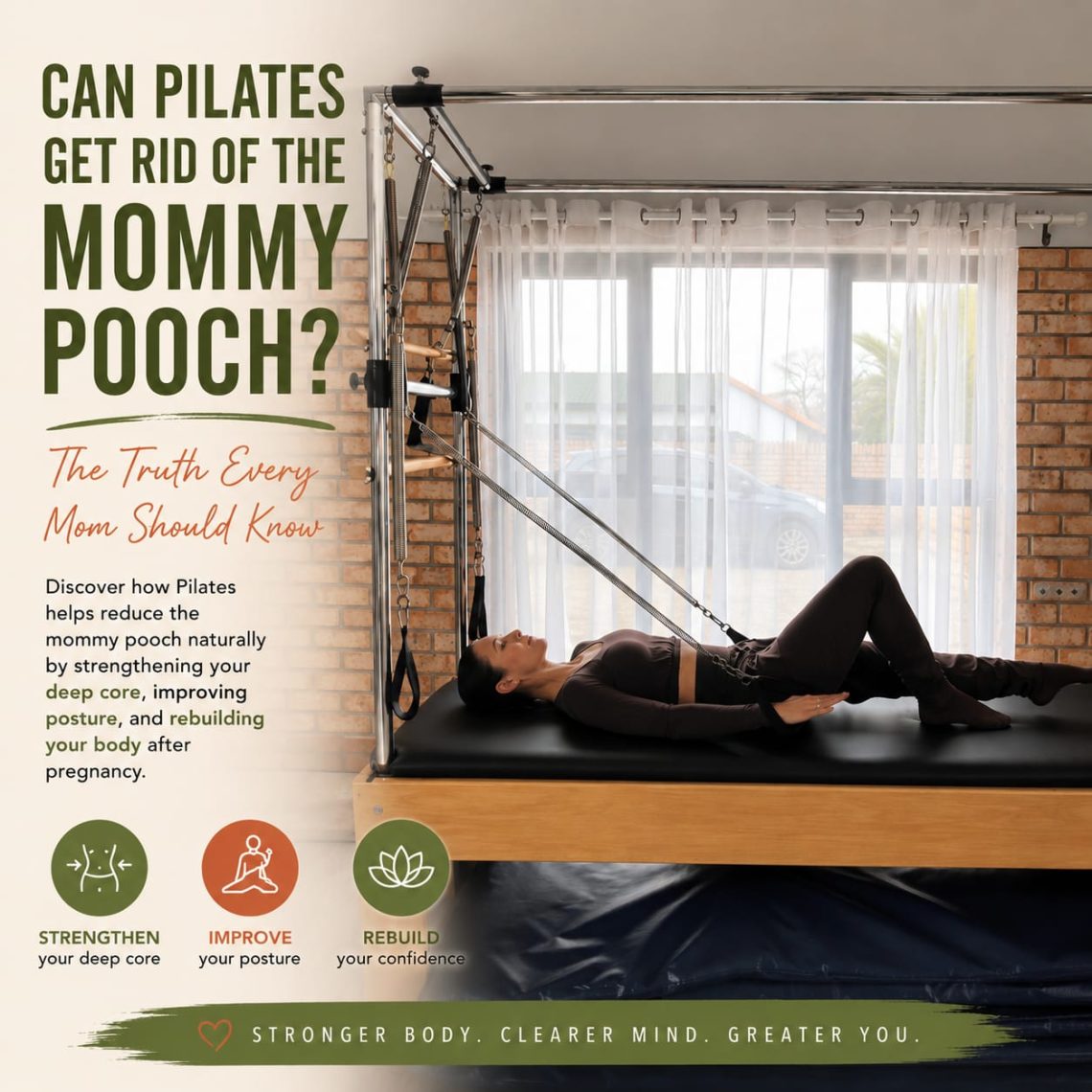
Can Pilates Get Rid of the Mommy Pooch? The Truth Every Mom Should Know
If you’ve been faithfully doing crunches, running for miles, or following every “flat stomach” workout you can find online, yet your lower belly still sticks out, you’re not alone.
Many moms become frustrated because they assume that stubborn lower belly is simply body fat. In reality, the so-called mommy pooch is often much more complex.
Pregnancy changes the entire core system. Your abdominal muscles stretch, your posture shifts, your breathing changes, your pelvic floor adapts, and your connective tissues undergo incredible transformation.
The good news?
Your body is designed to recover.
And one of the safest and most effective ways to support that recovery is through Pilates.
In this guide, you’ll learn:
- What actually causes the mommy pooch
- Whether Pilates really works
- The biggest mistakes women make
- The best Pilates exercises for recovery
- What realistic results look like
- How to start rebuilding your core naturally
Can Pilates Get Rid of the Mommy Pooch?
The short answer
Yes.
Pilates can help reduce the appearance of a mommy pooch by improving deep core activation, posture, breathing mechanics, pelvic stability, and overall strength.
However, Pilates isn’t a magic exercise.
The best results happen when the exercises address the underlying cause of your lower belly rather than simply trying to burn calories.
What Exactly Is the Mommy Pooch?
The term “mommy pooch” describes the lower abdominal bulge that many women notice after pregnancy.
Despite the name, not every mommy pooch is caused by the same thing.
In fact, several factors may contribute:
- weakened deep core muscles
- stretched abdominal wall
- diastasis recti
- changes in connective tissue
- altered posture
- anterior pelvic tilt
- weakened glutes
- loose skin
- increased body fat
- reduced muscle tone
Many women have more than one contributing factor.
That’s why copying someone else’s workout rarely produces the same results.
Why Crunches Often Don’t Work
This surprises many women.
Traditional abdominal exercises mainly strengthen the rectus abdominis—the “six-pack” muscle.
But the muscle that acts like your body’s natural corset is the transverse abdominis.
If this deeper muscle isn’t functioning well, you may continue to see lower abdominal bulging despite doing hundreds of crunches.
In some situations, high-pressure abdominal exercises may even make abdominal doming more noticeable, particularly for women with diastasis recti.
Rather than starting with intensity, Pilates focuses on restoring control.
Why Pilates Is Different
Pilates isn’t just about getting stronger.
It’s about teaching your body how to move efficiently again.
Instead of isolating one muscle, Pilates retrains the entire core system to work together.
That includes:
- diaphragm
- deep abdominal muscles
- pelvic floor
- multifidus
- glutes
- spinal stabilisers
When these muscles coordinate properly, your body becomes stronger, more stable, and often appears flatter naturally.
The Five Pillars of a Flatter Lower Belly
1. Deep Core Activation
Your deepest abdominal muscle wraps around your waist like a corset.
Pilates teaches you how to activate this muscle without excessive pressure.
This creates better spinal support and improved abdominal control.
2. Better Posture
Pregnancy often changes how we stand.
Forward shoulders, flared ribs, and an anterior pelvic tilt can all make the lower belly appear larger.
Improving alignment doesn’t just help your back—it can immediately change how your abdomen looks.
3. Breathing Mechanics
Your diaphragm and pelvic floor work together with your deep core.
Learning to breathe efficiently helps restore normal pressure inside the abdomen.
Pilates places enormous emphasis on breathing because every movement begins there.
4. Glute Strength
Weak glutes often contribute to poor pelvic positioning.
Stronger glutes help support the pelvis, improve posture, and reduce compensation through the lower back.
This is one reason why Pilates includes much more than abdominal exercises.
5. Functional Movement
Recovery doesn’t happen only during exercise.
How you:
- lift your child
- stand
- sit
- carry shopping
- climb stairs
- breathe
all influence how your core functions throughout the day.
Pilates teaches movement patterns you use in everyday life.
The Best Pilates Exercises for the Mommy Pooch
If you’re just getting started, focus on quality rather than quantity.
Excellent beginner exercises include:
Diaphragmatic Breathing
Reconnects your breathing muscles and deep core.
Pelvic Tilts
Improves pelvic awareness and spinal mobility.
Heel Slides
Builds core stability while keeping pressure manageable.
Toe Taps
Progresses deep core control without excessive strain.
Dead Bug
Develops coordination between the arms, legs, and trunk.
Shoulder Bridge
Strengthens the glutes while encouraging pelvic stability.
Bird Dog
Improves cross-body stability and spinal control.
Side-Lying Leg Series
Builds hip stability, glute strength, and pelvic control.
Common Mistakes That Slow Recovery
Many women unknowingly delay progress by:
- rushing into advanced ab workouts
- holding their breath
- exercising through abdominal doming
- focusing only on calories burned
- ignoring posture
- neglecting strength training
- expecting overnight results
Recovery is about rebuilding function, not punishing your body.
How Long Does It Take to See Results?
Every woman is different.
Recovery depends on factors such as:
- number of pregnancies
- delivery method
- consistency
- sleep
- nutrition
- overall activity
- individual healing
Many women notice:
2–4 weeks
- improved posture
- greater body awareness
- easier core activation
4–8 weeks
- increased strength
- better stability
- improved confidence during daily activities
8–12 weeks
Many women begin noticing visible changes in abdominal shape alongside improved function, although timelines vary from person to person.
Remember that appearance is only one part of recovery. Improved strength, confidence, and movement quality are equally important outcomes.
Frequently Asked Questions
Can Pilates fix diastasis recti?
Pilates can be part of a rehabilitation programme for some women with diastasis recti by improving deep core control and movement patterns. Because every case is different, it’s important to be assessed by a qualified healthcare professional or experienced instructor if you suspect you have significant abdominal separation.
Is walking enough?
Walking is excellent for cardiovascular health and overall wellbeing, but it doesn’t specifically retrain deep core coordination.
Should I avoid crunches?
Not necessarily. Some women can safely include crunches later in their recovery. The timing depends on individual factors such as symptoms, movement quality, and core control.
Can loose skin tighten naturally?
Skin changes vary widely. Gradual improvements may occur over time, particularly with healthy nutrition, strength training, and overall skin care, but results depend on factors such as genetics, age, and the degree of stretching.
Can Pilates reduce belly fat?
Pilates contributes to energy expenditure, builds muscle, and supports an active lifestyle. Fat loss, however, depends on overall energy balance, nutrition, and lifestyle—not one exercise alone.
The Bottom Line
Your body didn’t change overnight during pregnancy.
It won’t recover overnight either.
But the mommy pooch isn’t something you need to fight.
It’s often a sign that your body needs reconnection, coordination, and strength.
Pilates provides exactly that.
Instead of focusing only on burning calories, Pilates rebuilds your body from the inside out—helping you move better, stand taller, feel stronger, and support your core in everyday life.
Small, consistent steps can lead to meaningful changes over time.
Ready to Begin?
If you’re a busy mom who only has 15 minutes a day, I created the exact programme I wish every woman had after pregnancy.
The 15-Minute Mom Body Reset combines progressive Pilates workouts, deep core training, posture improvement, breathing techniques, and full-body strengthening into short, achievable sessions that fit into real life.
No endless crunches.
No two-hour workouts.
Just a structured plan designed to help you rebuild your strength, confidence, and movement—one session at a time.
Start your 15-Minute Mom Body Reset today and begin rebuilding your body from the inside out.